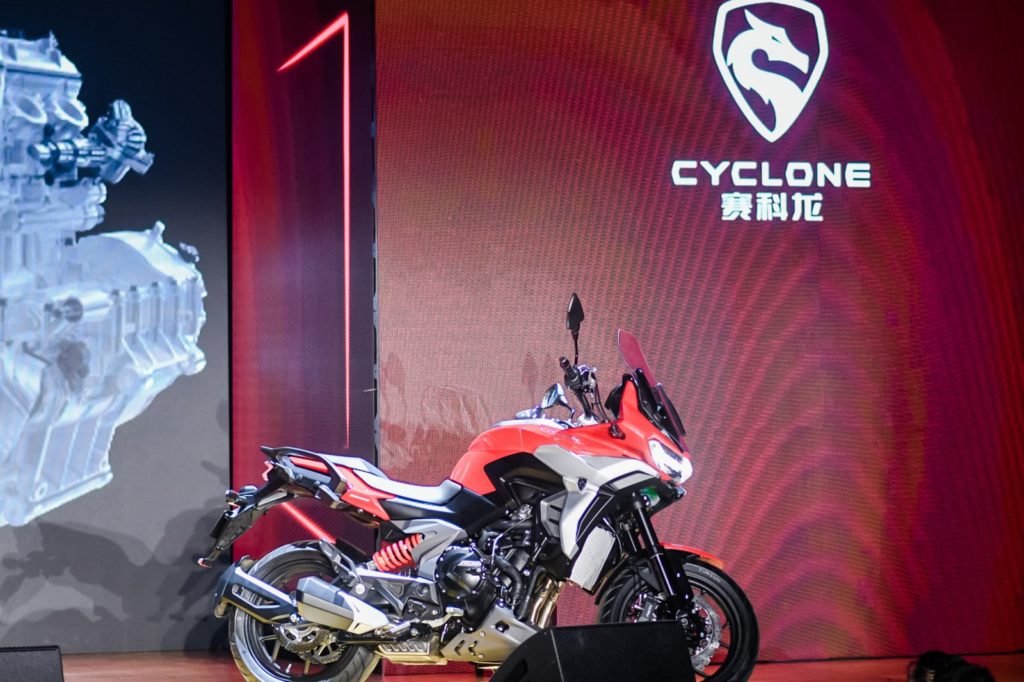
Norton-Derived 650cc Parallel Twin: The Heart of the RX6
The Zongshen Cyclone RX6 is powered by a 650cc parallel-twin engine that traces its lineage directly to Norton Motorcycles. In 2017, Zongshen acquired the rights to Norton's 650cc twin design, originally developed for the Norton Atlas. This engine was engineered by Ricardo, the British motorsport consultancy, and features a 270-degree crankshaft that gives it a V-twin-like firing order and a throaty exhaust note.
In the RX6, the engine produces a claimed 61 horsepower at 8,500 rpm and 45 lb-ft of torque at 7,000 rpm. These numbers put it squarely in the middleweight ADV class, competing with the Kawasaki Versys 650 (67 hp) and the Suzuki V-Strom 650 (71 hp). However, the RX6's torque curve is notably flat, with over 80% of peak torque available from 3,500 rpm to 7,500 rpm. This makes the bike exceptionally tractable in real-world riding, especially when loaded with luggage or climbing mountain passes.
During our testing, the RX6 pulled cleanly from 2,500 rpm in sixth gear without lugging, a testament to the engine's flexible character. The fuel injection is smooth and responsive, though we noticed a slight flat spot around 4,500 rpm that Zongshen could address with a future ECU update. The six-speed gearbox shifts positively, if not quite as slick as a Japanese unit, and the slipper clutch is a welcome addition for aggressive downshifts.
One of the most impressive aspects of the Norton-derived engine is its refinement. At highway speeds of 70-80 mph, the RX6 hums along at 5,500-6,000 rpm with minimal vibration. The counterbalancer does an excellent job of quelling the inherent buzz of a parallel twin. This is a significant achievement for a Chinese manufacturer and suggests that Zongshen invested heavily in the engine's development rather than simply copying an existing design.
Key Stat: The Zongshen Cyclone RX6's 650cc engine delivers 80% of its peak torque from 3,500 rpm to 7,500 rpm, providing exceptional real-world flexibility that rivals engines costing twice as much.
Adventure Capability: Suspension, Ground Clearance, and Electronics
The RX6 is built on a steel trellis frame with a bolt-on aluminum subframe, a design choice that balances strength with weight savings. The suspension consists of a fully adjustable 43mm inverted fork from KYB and a remote-reservoir rear shock, also from KYB, with adjustable preload and rebound damping. Both ends offer 5.9 inches of travel, which is competitive with the BMW F 850 GS (6.7 inches) and the KTM 890 Adventure (7.9 inches).
Ground clearance measures 8.3 inches, enough to clear most rocks and ruts on graded dirt roads. The seat height is 32.3 inches, which is manageable for most riders but may be tall for shorter inseams. Zongshen offers a low seat option that drops the height to 31.5 inches, a thoughtful touch for a bike in this class.
Where the RX6 falls short of European and Japanese competition is in electronic rider aids. The bike comes with switchable ABS and a basic traction control system that can be turned off for off-road riding. There are no riding modes, no cornering ABS, no quickshifter, and no cruise control. The TFT display is bright and readable, but the interface is basic, with no smartphone connectivity or navigation.
For the target buyer--someone who wants to explore gravel roads and fire trails rather than tackle hard-core enduro routes--the RX6's electronics are adequate. The ABS is well-calibrated for on-road use and can be disabled at the rear wheel for loose surfaces. The traction control is conservative but effective, cutting power smoothly when it detects wheel spin. However, serious off-road riders will miss the ability to fine-tune intervention levels.
Build Quality and Component Selection: Where Zongshen Cut Corners and Where They Didn't
The RX6 presents a mixed picture when it comes to build quality. On the positive side, Zongshen used premium components in key areas: KYB suspension, Nissin brakes (dual 320mm front discs with four-piston calipers), and a Pirelli Scorpion Trail II tires as standard equipment. The switchgear is from a tier-one supplier and feels solid, with positive detents and a damped action. The paint quality on the fuel tank and body panels is excellent, with deep metallic flake and a thick clear coat.
However, there are areas where cost-cutting is evident. The handguards are plastic and flimsy, offering minimal protection in a tip-over. The side stand is thin and lacks a large footpad, causing it to sink into soft ground. The toolkit is basic, and the owner's manual is poorly translated. The seat foam is firm, which is fine for short rides but becomes uncomfortable after two hours in the saddle.
The wiring harness is neatly routed and protected with split loom, a sign that Zongshen paid attention to durability. The fasteners are a mix of metric hex and Allen bolts, and most are of reasonable quality. However, we found a few bolts on the bodywork that were already showing surface rust after a week of riding in wet conditions. This is a minor annoyance but points to inconsistent quality control.
Overall, the RX6's build quality is a step above what we've seen from other Chinese manufacturers like CFMoto or QJ Motor. Zongshen clearly benchmarked the BMW F 850 GS and the Suzuki V-Strom 650 when designing this bike, and it shows in the overall fit and finish. The gaps between body panels are even, the welds on the frame are clean, and the components are well-sorted.
Price Comparison: Does the RX6 Justify the Trade-Offs?
The Zongshen Cyclone RX6 is priced at $8,499 in the United States, which undercuts the Kawasaki Versys 650 ($8,999) by $500, the Suzuki V-Strom 650 ($9,299) by $800, and the BMW F 850 GS ($13,995) by a staggering $5,496. For the price of a base-model BMW, you could buy the RX6 and have enough left over for a full set of luggage, a quickshifter, and a weekend trip.
But price alone doesn't tell the whole story. The RX6 offers a 650cc engine with genuine Norton DNA, premium suspension and brakes, and a level of fit and finish that approaches Japanese standards. What you give up are the electronic rider aids, dealer network support, and resale value that come with established brands. A three-year-old BMW F 850 GS will still fetch 60-70% of its original MSRP, while a three-year-old RX6 will likely be worth 40-50% at best.
For the rider who plans to keep the bike for 5-7 years and ride it daily, the RX6 makes compelling financial sense. The $5,500 savings over the BMW could cover fuel, tires, and maintenance for several years. The RX6 is also simpler to work on, with no complex electronics to diagnose and no expensive dealer-only parts. Zongshen offers a two-year, unlimited-mileage warranty, which provides some peace of mind.
However, if you plan to trade up within two years or need the latest safety electronics, the RX6 is not the right choice. The lack of cornering ABS and riding modes will be a dealbreaker for tech-savvy riders. The dealer network is also limited, with only 200 Zongshen dealers in the US compared to over 1,000 for BMW. This means longer wait times for parts and service, especially in rural areas.
In conclusion, the Zongshen Cyclone RX6 is a legitimate alternative to the BMW GS for the budget-conscious adventure rider who values mechanical simplicity and real-world performance over electronic gadgets. It's not a perfect bike, but at $8,499, it doesn't need to be. The Norton-derived engine is a gem, the suspension is competent, and the build quality is better than expected. If you can live without the latest tech and a robust dealer network, the RX6 delivers 80% of the GS experience for 60% of the price.