Table of Contents
- 1. Bike Specifications: Production-Based WSBK vs Purpose-Built MotoGP Prototypes
- 2. Cost Differences: Why WSBK Bikes Cost $200K and MotoGP Bikes Cost $2M+
- 3. Rider Career Paths: How Riders Move Between the Two Championships
- 4. Which Series Offers Better Racing? Lap Time Comparisons and Overtaking Statistics
1. Bike Specifications: Production-Based WSBK vs Purpose-Built MotoGP Prototypes
The most fundamental difference between World Superbike (WSBK) and MotoGP lies in the machines themselves. WSBK bikes are derived from production motorcycles that you can buy at a dealership, while MotoGP bikes are purpose-built prototypes with no road-going equivalent.
WSBK regulations require manufacturers to homologate their bikes by producing at least 500 units for sale to the public. This means the Ducati Panigale V4 R, Yamaha R1, and Kawasaki ZX-10RR you see on track share their basic architecture with showroom models. However, teams can modify engines, suspension, electronics, and aerodynamics within strict rules. For example, WSBK engines are limited to 1,000cc for four-cylinder bikes and 1,200cc for twins, with maximum revs capped at 15,000 RPM. The result is a bike producing around 230-240 horsepower, weighing approximately 168 kg (370 lbs) with rider.
In contrast, MotoGP prototypes are built from scratch by factories like Ducati, Yamaha, Honda, and KTM. They use 1,000cc four-stroke engines that rev to 18,000+ RPM, producing over 280 horsepower. These bikes weigh just 157 kg (346 lbs) without fuel, and use advanced technologies like seamless shift gearboxes, carbon fiber chassis, and sophisticated aerodynamics including ground-effect fairings and ride-height devices. The 2024 Ducati Desmosedici GP24, for instance, features a V4 engine with pneumatic valves and a carbon fiber swingarm--components that would be illegal in WSBK.
Key stat: MotoGP bikes produce roughly 40-50 more horsepower than WSBK bikes and weigh 11 kg less, giving them a power-to-weight ratio that is 20-25% higher.
2. Cost Differences: Why WSBK Bikes Cost $200K and MotoGP Bikes Cost $2M+
The financial chasm between the two series is staggering. A competitive WSBK machine costs around $200,000 to $300,000 to build and run per season, while a top-tier MotoGP prototype can exceed $2 million per bike. This 10x cost multiplier stems from the prototype nature of MotoGP and the R&D investment required.
In WSBK, teams start with a production bike costing $20,000-$30,000. They then add race-spec components: Öhlins suspension ($15,000), Brembo brakes ($8,000), magnesium wheels ($5,000), a full exhaust system ($3,000), and ECU tuning ($2,000). Engine modifications are limited, so teams focus on chassis setup, electronics calibration, and tire management. A full season budget for a privateer WSBK team might be $1-2 million, including salaries, travel, and parts.
MotoGP budgets are astronomical. Factory teams like Ducati Lenovo spend $50-100 million annually across two riders. Each bike costs $2-3 million to build, with the engine alone costing $500,000 due to exotic materials like titanium connecting rods and carbon fiber valves. The electronics package--including IMU sensors, traction control, and anti-wheelie systems--costs $200,000 per bike. Aerodynamic development, including wind tunnel testing and CFD simulation, adds millions more. Even satellite teams running year-old bikes spend $5-10 million per season.
Expert tip: The cost gap means WSBK is more accessible for privateers and smaller manufacturers, while MotoGP is an exclusive club for the world's largest motorcycle brands with deep pockets.
3. Rider Career Paths: How Riders Move Between the Two Championships
The relationship between WSBK and MotoGP is complex, with riders often moving between the two series depending on their career stage, performance, and opportunities. Historically, WSBK was seen as a stepping stone to MotoGP, but the dynamic has shifted in recent years.
Many riders start in national championships like the British Superbike Championship (BSB) or the FIM CEV Repsol Moto3 Junior World Championship. From there, they typically progress to Moto3 or Moto2 in the Grand Prix paddock, or directly to WSBK. The most successful MotoGP riders--like Marc Márquez, Fabio Quartararo, and Francesco Bagnaia--came through the Moto3/Moto2 pipeline, bypassing WSBK entirely. However, riders like Jonathan Rea (six-time WSBK champion) and Toprak Razgatlıoğlu have dominated WSBK without ever racing in MotoGP.
The crossover is more common in the opposite direction. Riders who struggle in MotoGP often find success in WSBK. Examples include Andrea Dovizioso (MotoGP runner-up, then WSBK), Cal Crutchlow (MotoGP race winner, now WSBK test rider), and Danilo Petrucci (MotoGP race winner, now WSBK podium finisher). The 2024 season saw Álex Márquez move from MotoGP to WSBK, while 2025 brought rumors of Jorge Martín considering a switch. This flow creates a talent-rich WSBK grid with experienced MotoGP refugees.
Key stat: Only 3 riders in the last decade have won races in both MotoGP and WSBK: Max Biaggi, Marco Melandri, and Andrea Dovizioso.
4. Which Series Offers Better Racing? Lap Time Comparisons and Overtaking Statistics
When comparing the quality of racing, both series have strengths, but the data reveals distinct differences. MotoGP bikes are faster, but WSBK often produces closer, more unpredictable races.
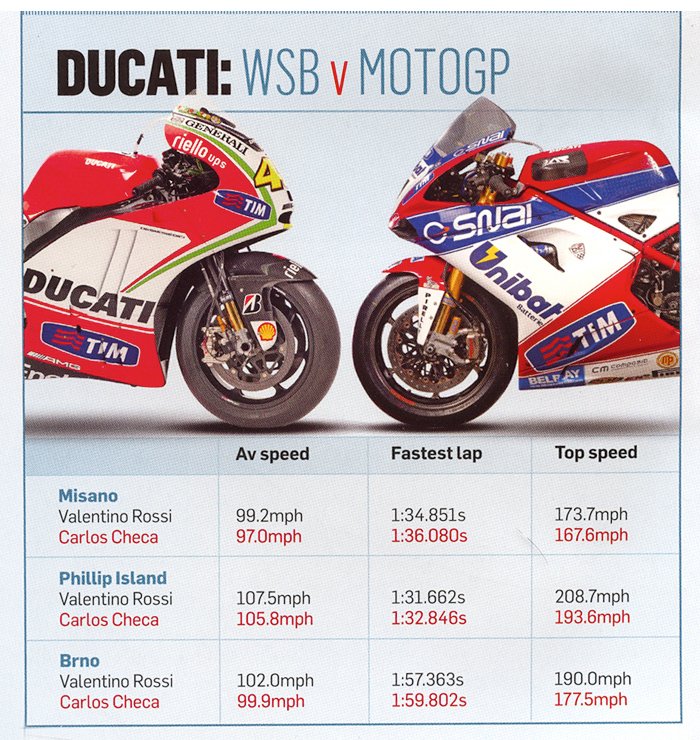
Lap time comparisons show MotoGP is significantly faster. At the Circuit de Barcelona-Catalunya, a MotoGP pole lap is around 1:38, while a WSBK pole is about 1:41--a 3-second gap. At Phillip Island, the difference is 1:28 vs 1:30. This speed advantage comes from the prototype's superior power, aerodynamics, and cornering ability. However, WSBK bikes are closer to production models, meaning riders must work harder to extract performance, leading to more rider influence on results.
Overtaking statistics favor WSBK. Data from the 2023 season shows an average of 12 overtakes per race in WSBK compared to 8 in MotoGP. The reasons are twofold: WSBK bikes have less aerodynamic downforce, making slipstreaming more effective, and the production-based chassis means riders can use different lines through corners. MotoGP's advanced aerodynamics create turbulent air that makes following difficult, reducing overtaking opportunities. Additionally, WSBK's longer races (typically 20-22 laps vs MotoGP's 25-27 laps) and mandatory pit stops for tire changes in some rounds add strategic variety.
Ultimately, MotoGP offers the pinnacle of motorcycle technology and speed, while WSBK delivers closer, more accessible racing with production-based machines. For fans who appreciate engineering marvels, MotoGP is unmatched. For those who enjoy wheel-to-wheel battles and underdog stories, WSBK often delivers more excitement per race.
Choosing the right motorcycle involves more than picking a color you like. Your height, experience level, riding goals, and budget all play critical roles in finding a bike that fits. Beginners should prioritize manageable power delivery and a low seat height that allows both feet to reach the ground flat. Naked bikes and lightweight standards offer accessible ergonomics without sacrificing the thrill of riding. Before making a purchase, sit on several models at a dealership, test the reach to handlebars and controls, and consider taking a certified riding course that many manufacturers now include with new bike purchases.
Riding safety extends far beyond wearing a helmet. Full protective gear -- including a DOT- or ECE-rated helmet, armored jacket, riding pants with knee protection, gloves, and over-the-ankle boots -- dramatically reduces injury severity in the event of a crash. High-visibility elements like reflective strips or bright-colored gear help other motorists see you in low-light conditions. Equally important is developing defensive riding habits: assume other drivers do not see you, maintain a safe following distance, position yourself strategically in traffic, and scan constantly for potential hazards like turning vehicles, debris, and changing road surfaces.
Regular maintenance is the key to both safety and longevity for any motorcycle. Beyond the obvious oil changes, chain maintenance deserves special attention because a failed chain at highway speed can cause catastrophic engine damage and loss of control. Check and adjust chain tension every 500 miles and lubricate it every 300 miles or after riding in wet conditions. Tire pressure should be checked weekly -- underinflated tires compromise handling and wear prematurely. Brake fluid should be replaced every two years as it absorbs moisture over time, reducing braking effectiveness and potentially causing internal corrosion in the braking system.
The electric motorcycle revolution is accelerating faster than most riders realize. Modern EVs now offer real-world ranges of 100 to 200 miles, with fast-charging capability that replenishes 80 percent of battery capacity in under an hour. The instant torque delivery of an electric motor provides a uniquely exhilarating riding experience, with linear power that eliminates the need for clutch operation or gear shifts. Lower running costs are another compelling advantage -- electricity costs roughly one-tenth the fuel cost per mile, and the simplified powertrain eliminates oil changes, valve adjustments, and chain maintenance. Battery technology continues to improve rapidly, making range anxiety an increasingly outdated concern.
Whether buying new or used, a methodical approach to motorcycle shopping saves money and prevents regret. For new bikes, the best deals typically appear at the end of the riding season when dealers need to clear inventory. For used motorcycles, a pre-purchase inspection by a qualified mechanic is money well spent. Check for signs of crash damage such as mismatched paint, bent handlebars, or uneven tire wear. Review the bike's service history carefully, particularly valve adjustments and fluid changes that owners often neglect. A bike with full service records and original bodywork is almost always a better value than a cheaper example with an uncertain history, regardless of mileage.
Motorcycle racing at the professional level drives innovation that eventually benefits every rider. Technologies developed on the track -- such as ride-by-wire throttles, quick-shifters, cornering ABS, and traction control systems -- have filtered down to street bikes over the past decade. Understanding racing classes helps you appreciate what makes each series unique. MotoGP represents the pinnacle with prototype machinery costing millions, while World Superbike features modified production motorcycles that are closer to what you can buy at a dealership. Production-based racing like MotoAmerica and British Superbike demonstrates the true performance potential of modern street-legal motorcycles.
Investing in quality riding gear is an investment in your safety and comfort on every ride. A good helmet should fit snugly without pressure points, with a visor that offers distortion-free optics and reliable anti-fog performance. Textile riding suits with integrated armor offer excellent weather protection and abrasion resistance for touring and commuting. Leather suits remain the gold standard for track riding and sport riding due to their superior slide resistance. Gloves should have reinforced palms and knuckle protection. Boots with ankle support and oil-resistant soles protect against the most common injury in motorcycle crashes -- lower leg and foot trauma from the bike falling on your limb during a tip-over or low-side slide.
Expert tip: If you want to see the fastest motorcycles on Earth, watch MotoGP. If you want to see the best racing with more passing and drama, WSBK is often the better choice.