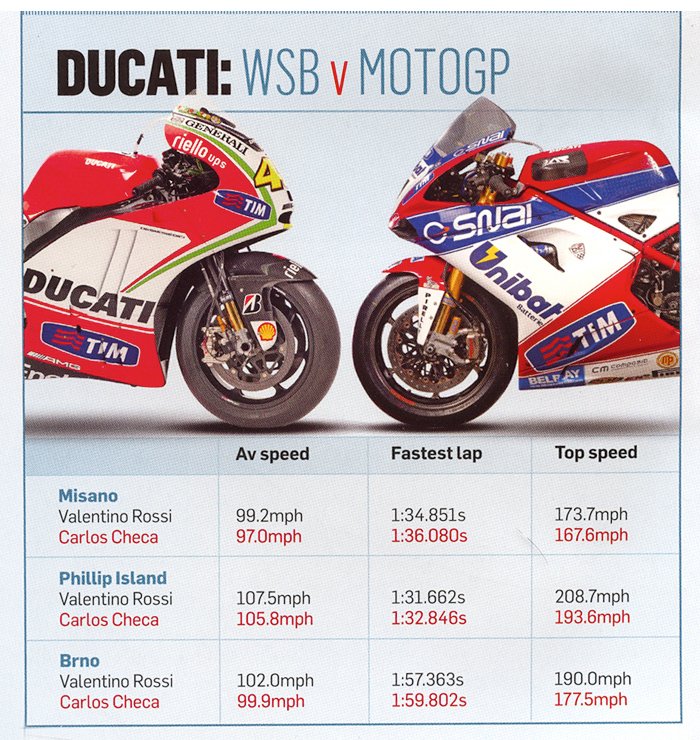
1. Bike Specifications: Production-Based WSBK vs Purpose-Built MotoGP Prototypes
The most fundamental difference between World Superbike (WSBK) and MotoGP lies in the machines themselves. WSBK bikes are derived from production motorcycles that you can buy at a dealership, while MotoGP bikes are purpose-built prototypes with no road-going equivalent.
WSBK regulations require manufacturers to homologate their bikes by producing at least 500 units for sale to the public. This means the Ducati Panigale V4 R, Yamaha R1, and Kawasaki ZX-10RR you see on track share their basic architecture with showroom models. However, teams can modify engines, suspension, electronics, and aerodynamics within strict rules. For example, WSBK engines are limited to 1,000cc for four-cylinder bikes and 1,200cc for twins, with maximum revs capped at 15,000 RPM. The result is a bike producing around 230-240 horsepower, weighing approximately 168 kg (370 lbs) with rider.
In contrast, MotoGP prototypes are built from scratch by factories like Ducati, Yamaha, Honda, and KTM. They use 1,000cc four-stroke engines that rev to 18,000+ RPM, producing over 280 horsepower. These bikes weigh just 157 kg (346 lbs) without fuel, and use advanced technologies like seamless shift gearboxes, carbon fiber chassis, and sophisticated aerodynamics including ground-effect fairings and ride-height devices. The 2024 Ducati Desmosedici GP24, for instance, features a V4 engine with pneumatic valves and a carbon fiber swingarm--components that would be illegal in WSBK.
Key stat: MotoGP bikes produce roughly 40-50 more horsepower than WSBK bikes and weigh 11 kg less, giving them a power-to-weight ratio that is 20-25% higher.
2. Cost Differences: Why WSBK Bikes Cost $200K and MotoGP Bikes Cost $2M+
The financial chasm between the two series is staggering. A competitive WSBK machine costs around $200,000 to $300,000 to build and run per season, while a top-tier MotoGP prototype can exceed $2 million per bike. This 10x cost multiplier stems from the prototype nature of MotoGP and the R&D investment required.
In WSBK, teams start with a production bike costing $20,000-$30,000. They then add race-spec components: Öhlins suspension ($15,000), Brembo brakes ($8,000), magnesium wheels ($5,000), a full exhaust system ($3,000), and ECU tuning ($2,000). Engine modifications are limited, so teams focus on chassis setup, electronics calibration, and tire management. A full season budget for a privateer WSBK team might be $1-2 million, including salaries, travel, and parts.
MotoGP budgets are astronomical. Factory teams like Ducati Lenovo spend $50-100 million annually across two riders. Each bike costs $2-3 million to build, with the engine alone costing $500,000 due to exotic materials like titanium connecting rods and carbon fiber valves. The electronics package--including IMU sensors, traction control, and anti-wheelie systems--costs $200,000 per bike. Aerodynamic development, including wind tunnel testing and CFD simulation, adds millions more. Even satellite teams running year-old bikes spend $5-10 million per season.
Expert tip: The cost gap means WSBK is more accessible for privateers and smaller manufacturers, while MotoGP is an exclusive club for the world's largest motorcycle brands with deep pockets.
3. Rider Career Paths: How Riders Move Between the Two Championships
The relationship between WSBK and MotoGP is complex, with riders often moving between the two series depending on their career stage, performance, and opportunities. Historically, WSBK was seen as a stepping stone to MotoGP, but the dynamic has shifted in recent years.
Many riders start in national championships like the British Superbike Championship (BSB) or the FIM CEV Repsol Moto3 Junior World Championship. From there, they typically progress to Moto3 or Moto2 in the Grand Prix paddock, or directly to WSBK. The most successful MotoGP riders--like Marc Márquez, Fabio Quartararo, and Francesco Bagnaia--came through the Moto3/Moto2 pipeline, bypassing WSBK entirely. However, riders like Jonathan Rea (six-time WSBK champion) and Toprak Razgatlıoğlu have dominated WSBK without ever racing in MotoGP.
The crossover is more common in the opposite direction. Riders who struggle in MotoGP often find success in WSBK. Examples include Andrea Dovizioso (MotoGP runner-up, then WSBK), Cal Crutchlow (MotoGP race winner, now WSBK test rider), and Danilo Petrucci (MotoGP race winner, now WSBK podium finisher). The 2024 season saw Álex Márquez move from MotoGP to WSBK, while 2025 brought rumors of Jorge Martín considering a switch. This flow creates a talent-rich WSBK grid with experienced MotoGP refugees.
Key stat: Only 3 riders in the last decade have won races in both MotoGP and WSBK: Max Biaggi, Marco Melandri, and Andrea Dovizioso.
4. Which Series Offers Better Racing? Lap Time Comparisons and Overtaking Statistics
When comparing the quality of racing, both series have strengths, but the data reveals distinct differences. MotoGP bikes are faster, but WSBK often produces closer, more unpredictable races.
Lap time comparisons show MotoGP is significantly faster. At the Circuit de Barcelona-Catalunya, a MotoGP pole lap is around 1:38, while a WSBK pole is about 1:41--a 3-second gap. At Phillip Island, the difference is 1:28 vs 1:30. This speed advantage comes from the prototype's superior power, aerodynamics, and cornering ability. However, WSBK bikes are closer to production models, meaning riders must work harder to extract performance, leading to more rider influence on results.
Overtaking statistics favor WSBK. Data from the 2023 season shows an average of 12 overtakes per race in WSBK compared to 8 in MotoGP. The reasons are twofold: WSBK bikes have less aerodynamic downforce, making slipstreaming more effective, and the production-based chassis means riders can use different lines through corners. MotoGP's advanced aerodynamics create turbulent air that makes following difficult, reducing overtaking opportunities. Additionally, WSBK's longer races (typically 20-22 laps vs MotoGP's 25-27 laps) and mandatory pit stops for tire changes in some rounds add strategic variety.
Ultimately, MotoGP offers the pinnacle of motorcycle technology and speed, while WSBK delivers closer, more accessible racing with production-based machines. For fans who appreciate engineering marvels, MotoGP is unmatched. For those who enjoy wheel-to-wheel battles and underdog stories, WSBK often delivers more excitement per race.
Expert tip: If you want to see the fastest motorcycles on Earth, watch MotoGP. If you want to see the best racing with more passing and drama, WSBK is often the better choice.