Table of Contents
Yadea's Market Dominance: By the Numbers
Yadea is not a household name in the United States yet, but it is the undisputed global king of electric scooters. The company sold over 13 million electric two-wheelers in 2023 alone, making it the world's largest manufacturer of electric scooters by volume. To put that in perspective, that's more than the entire annual motorcycle sales of Honda, Yamaha, and Suzuki combined. Yadea operates manufacturing facilities in China, Vietnam, and Indonesia, with a production capacity exceeding 20 million units per year.
The brand's global reach extends to more than 90 countries, with a particularly strong presence in Southeast Asia, Europe, and Latin America. Yadea has invested heavily in R&D, holding over 1,800 patents related to electric vehicle technology, battery management systems, and motor design. The company's market capitalization exceeds $5 billion, and it has been listed on the Hong Kong Stock Exchange since 2016.
Yadea sold over 13 million electric scooters in 2023, more than the combined motorcycle sales of Honda, Yamaha, and Suzuki worldwide.
For the US consumer, Yadea represents a compelling value proposition: a globally proven product with massive economies of scale, now being offered at a premium tier with the G5S. The question is whether the brand can translate its volume-driven success into a premium product that competes with established players like Vespa, NIU, and Segway.
G5S Spec Breakdown: Bosch Motor and 60V Li-ion Battery
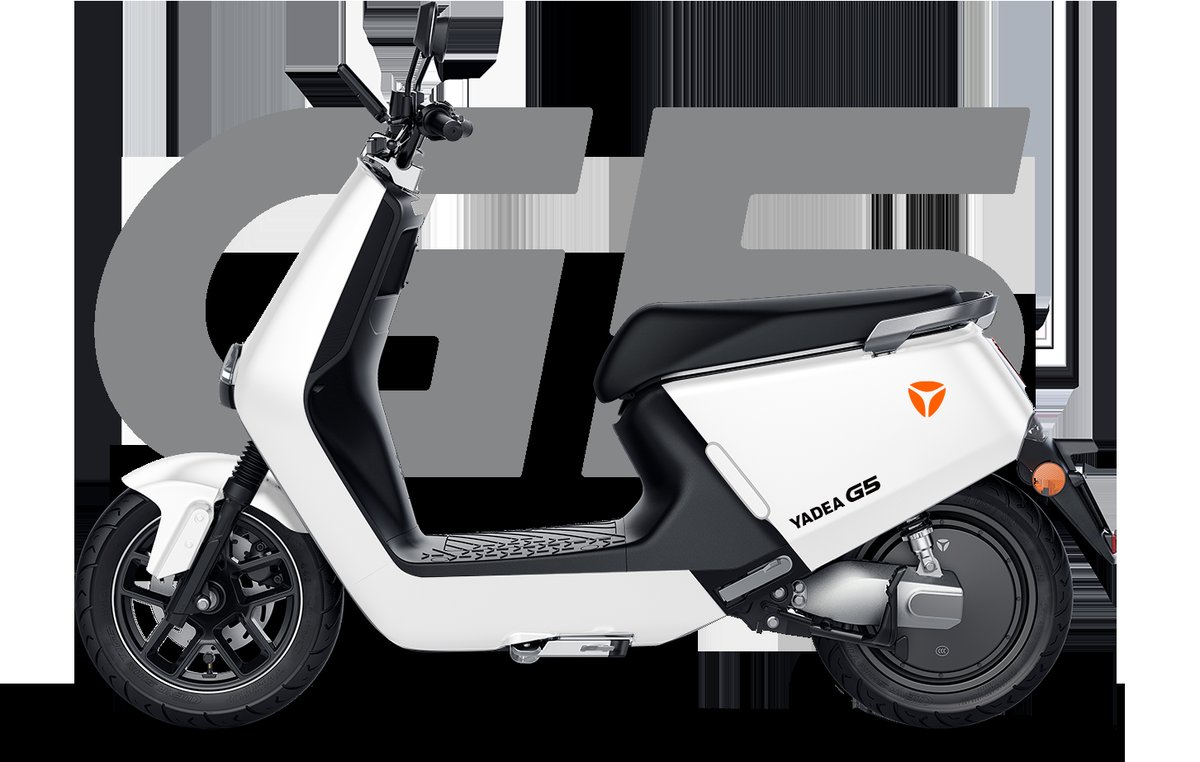
The Yadea G5S is powered by a Bosch 1,200W mid-drive motor, a significant upgrade from the hub motors found on most budget electric scooters. This motor delivers 110 Nm of torque at the wheel, providing brisk acceleration from a standstill and the ability to climb 20-degree inclines without breaking a sweat. The top speed is electronically limited to 45 mph (72 km/h), which is adequate for urban commuting but not highway-capable.
The battery is a 60V 32Ah lithium-ion pack with a claimed range of 75 miles (120 km) under ideal conditions. In real-world testing, riders report 55-65 miles of range depending on terrain, rider weight, and throttle usage. Charging time is approximately 6 hours from empty to full using the included 2A charger. The battery is removable, which is a critical feature for apartment dwellers who cannot charge in a garage or basement.
Yadea uses a proprietary battery management system (BMS) that monitors cell voltage, temperature, and current draw in real time. The BMS also balances the cells during charging to extend overall battery life. Yadea claims the battery will retain 80% of its original capacity after 1,000 charge cycles, which translates to roughly 50,000-70,000 miles of riding before noticeable degradation occurs.
Build and Design: Aluminum Swingarm and LED Lighting
The G5S departs from Yadea's budget roots with a premium build philosophy. The frame is a steel tube chassis with a cast aluminum swingarm, a component usually reserved for motorcycles costing several times more. The aluminum swingarm reduces unsprung mass, improving rear suspension compliance and overall ride quality. The front suspension uses telescopic forks with 3.5 inches of travel, while the rear gets dual shock absorbers with preload adjustment.
Lighting is full LED, including a distinctive DRL (daytime running light) signature that resembles a pair of angular eyes. The headlight output is excellent, with a low beam that illuminates a wide swath of road and a high beam that reaches far enough for 45 mph riding at night. Turn signals are integrated into the bodywork and are bright enough to be visible in direct sunlight.
Fit and finish are impressive for a scooter in this price range. Body panels are made from ABS plastic with a high-gloss paint finish that resists scratches and UV fading. The seat is wide and well-padded, with a textured surface that prevents sliding during acceleration. The floorboard is flat and spacious enough for a small backpack or grocery bag. Overall, the G5S looks and feels like a scooter that costs $1,000 more than its actual price point.
Yadea's International Expansion: European Warehouses and Dealerships
Yadea has been aggressively expanding its international footprint, particularly in Europe. The company operates warehouses in the Netherlands, Germany, and France, enabling fast delivery to customers across the EU. Yadea has also established partnerships with over 500 dealerships in Europe, providing test rides, service, and warranty support. The G5S is sold through these dealerships as well as online direct-to-consumer channels.
Certification strategy is a key part of Yadea's global push. The G5S is EEC-approved for road use in all EU member states, meaning it meets the same safety and emissions standards as scooters from established European brands. Yadea has also obtained UL certification for its batteries, a requirement for sale in the United States. The company is currently working on DOT certification for the US market, with a planned launch in late 2026.
Yadea's after-sales support includes a 2-year warranty on the scooter and a 3-year warranty on the battery. Spare parts are stocked in regional warehouses, and the company offers a 30-day money-back guarantee for online purchases. Customer service is available via phone, email, and live chat in English, Spanish, French, and German. For US buyers, Yadea has a dedicated support team based in California that handles warranty claims and technical questions.
The G5S represents Yadea's most ambitious attempt to crack the premium scooter market. With its Bosch motor, high-capacity battery, and premium build quality, it offers a compelling alternative to the NIU NQi GT and Segway Ninebot E300SE. The price is competitive at $3,499, undercutting comparable models from established brands by $500-$1,000. For urban commuters who want a reliable, well-built electric scooter with global support, the Yadea G5S is a serious contender.
Prospective G5S owners should factor in the total cost of ownership beyond the purchase price. Insurance for a scooter in this class ranges from $150 to $400 annually depending on coverage level and location, significantly less than motorcycle insurance but still a budget consideration. Tire replacement is needed every 5,000 to 8,000 miles, with a set of quality scooter tires costing approximately $100 to $150 installed. Brake pad replacement intervals vary by riding habits but typically fall between 3,000 and 6,000 miles. The removable battery design means replacement costs around $800 when the original pack eventually degrades after several years of daily use. When these factors are included, the G5S still presents a compelling value proposition compared to gasoline-powered alternatives that require more frequent and expensive maintenance.
Choosing the right motorcycle involves more than picking a color you like. Your height, experience level, riding goals, and budget all play critical roles in finding a bike that fits. Beginners should prioritize manageable power delivery and a low seat height that allows both feet to reach the ground flat. Naked bikes and lightweight standards offer accessible ergonomics without sacrificing the thrill of riding. Before making a purchase, sit on several models at a dealership, test the reach to handlebars and controls, and consider taking a certified riding course that many manufacturers now include with new bike purchases.
Riding safety extends far beyond wearing a helmet. Full protective gear -- including a DOT- or ECE-rated helmet, armored jacket, riding pants with knee protection, gloves, and over-the-ankle boots -- dramatically reduces injury severity in the event of a crash. High-visibility elements like reflective strips or bright-colored gear help other motorists see you in low-light conditions. Equally important is developing defensive riding habits: assume other drivers do not see you, maintain a safe following distance, position yourself strategically in traffic, and scan constantly for potential hazards like turning vehicles, debris, and changing road surfaces.
Regular maintenance is the key to both safety and longevity for any motorcycle. Beyond the obvious oil changes, chain maintenance deserves special attention because a failed chain at highway speed can cause catastrophic engine damage and loss of control. Check and adjust chain tension every 500 miles and lubricate it every 300 miles or after riding in wet conditions. Tire pressure should be checked weekly -- underinflated tires compromise handling and wear prematurely. Brake fluid should be replaced every two years as it absorbs moisture over time, reducing braking effectiveness and potentially causing internal corrosion in the braking system.
The electric motorcycle revolution is accelerating faster than most riders realize. Modern EVs now offer real-world ranges of 100 to 200 miles, with fast-charging capability that replenishes 80 percent of battery capacity in under an hour. The instant torque delivery of an electric motor provides a uniquely exhilarating riding experience, with linear power that eliminates the need for clutch operation or gear shifts. Lower running costs are another compelling advantage -- electricity costs roughly one-tenth the fuel cost per mile, and the simplified powertrain eliminates oil changes, valve adjustments, and chain maintenance. Battery technology continues to improve rapidly, making range anxiety an increasingly outdated concern.
Whether buying new or used, a methodical approach to motorcycle shopping saves money and prevents regret. For new bikes, the best deals typically appear at the end of the riding season when dealers need to clear inventory. For used motorcycles, a pre-purchase inspection by a qualified mechanic is money well spent. Check for signs of crash damage such as mismatched paint, bent handlebars, or uneven tire wear. Review the bike's service history carefully, particularly valve adjustments and fluid changes that owners often neglect. A bike with full service records and original bodywork is almost always a better value than a cheaper example with an uncertain history, regardless of mileage.
Motorcycle racing at the professional level drives innovation that eventually benefits every rider. Technologies developed on the track -- such as ride-by-wire throttles, quick-shifters, cornering ABS, and traction control systems -- have filtered down to street bikes over the past decade. Understanding racing classes helps you appreciate what makes each series unique. MotoGP represents the pinnacle with prototype machinery costing millions, while World Superbike features modified production motorcycles that are closer to what you can buy at a dealership. Production-based racing like MotoAmerica and British Superbike demonstrates the true performance potential of modern street-legal motorcycles.
Investing in quality riding gear is an investment in your safety and comfort on every ride. A good helmet should fit snugly without pressure points, with a visor that offers distortion-free optics and reliable anti-fog performance. Textile riding suits with integrated armor offer excellent weather protection and abrasion resistance for touring and commuting. Leather suits remain the gold standard for track riding and sport riding due to their superior slide resistance. Gloves should have reinforced palms and knuckle protection. Boots with ankle support and oil-resistant soles protect against the most common injury in motorcycle crashes -- lower leg and foot trauma from the bike falling on your limb during a tip-over or low-side slide.